
Introduction
The University of Chicago, often referred to as UChicago, is a private research university located in Chicago, Illinois. Renowned for its rigorous academic programs, intellectual environment, and groundbreaking contributions to research and innovation, UChicago has earned a reputation as one of the most prestigious institutions of higher learning in the world. Since its founding in 1890, the university has been a hub for scholars, thinkers, and innovators, making a profound impact on a diverse array of disciplines, from economics and physics to literature and the arts.
Historical Background
The University of Chicago was established in 1890 through the efforts of the American Baptist Education Society and a significant donation from oil magnate John D. Rockefeller. The institution’s founding president, William Rainey Harper, envisioned a university that combined the traditions of European research institutions with the liberal arts ideals of American colleges. The university officially opened its doors to students in 1892 and quickly distinguished itself as a leader in higher education.
From its inception, UChicago embraced a commitment to rigorous scholarship and intellectual inquiry. The university has consistently emphasized critical thinking, debate, and the pursuit of knowledge for its own sake, which has become a defining feature of its identity.
Academic Programs and Schools
The University of Chicago offers a wide range of academic programs across undergraduate, graduate, and professional levels. Its academic structure is divided into several schools and divisions, including:
- The College
The College is the undergraduate division of UChicago and is known for its Core Curriculum, which provides a common intellectual foundation for all students. The Core emphasizes interdisciplinary learning and critical thinking, with courses spanning humanities, social sciences, mathematics, and natural sciences. - Graduate Divisions
UChicago’s graduate divisions include the Biological Sciences Division, the Physical Sciences Division, the Social Sciences Division, and the Humanities Division. Each division fosters advanced research and scholarship in its respective fields. - Professional Schools
The university is home to several renowned professional schools, such as:- The Booth School of Business, consistently ranked among the top business schools globally.
- The Law School, known for its emphasis on interdisciplinary legal studies and its influential alumni.
- The Pritzker School of Medicine, a leader in medical education and research.
- The Harris School of Public Policy, which trains future policymakers and leaders.
- The School of Social Service Administration (SSA), now the Crown Family School of Social Work, Policy, and Practice, focusing on social work and social policy.
- The Divinity School
A cornerstone of UChicago’s intellectual heritage, the Divinity School is one of the oldest academic units of the university, offering programs in theology, religious studies, and the philosophy of religion.
Research and Innovation
The University of Chicago is synonymous with groundbreaking research and innovation. UChicago scholars have made transformative contributions across numerous fields. For example:
- Economics: The Chicago School of Economics, led by figures such as Milton Friedman and Gary Becker, has revolutionized economic thought and policy. UChicago economists have been awarded numerous Nobel Prizes for their work.
- Physics: The university was the site of the world’s first controlled nuclear chain reaction, led by Enrico Fermi and his team as part of the Manhattan Project.
- Sociology: UChicago is often considered the birthplace of modern sociology, with scholars such as Robert E. Park and Ernest Burgess pioneering urban sociology and social theory.
- Medicine: The university has been at the forefront of medical research, particularly in areas such as cancer treatment, genetics, and immunology.
Campus and Facilities
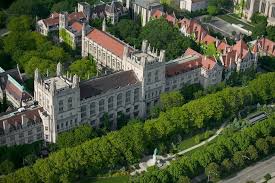
The University of Chicago’s main campus is located in the Hyde Park neighborhood of Chicago, a vibrant and diverse area that blends urban and residential environments. The campus is renowned for its Gothic architecture, with iconic buildings such as Rockefeller Chapel, Harper Memorial Library, and the Quadrangles providing a picturesque setting for academic life.
In addition to its historic buildings, the campus boasts state-of-the-art facilities for research and learning, including the Pritzker School of Molecular Engineering, the Mansueto Library, and the David Rubenstein Forum. The university also operates several affiliated research centers and institutes, such as the Argonne National Laboratory and the Marine Biological Laboratory.
The University of Chicago Library
The University of Chicago Library system is one of the largest and most comprehensive academic libraries in the United States. With over 11 million volumes, it serves as a vital resource for students, faculty, and researchers. The library’s collections span a vast array of disciplines and include rare manuscripts, archives, and digital resources.
Campus Life and Culture
UChicago’s campus life is as dynamic and intellectually stimulating as its academic programs. The university fosters a sense of community through a wide range of student organizations, cultural events, and extracurricular activities.
- Student Organizations: With over 450 student organizations, UChicago offers opportunities for students to engage in interests ranging from politics and social activism to arts and entrepreneurship.
- The Arts: The university supports a thriving arts community, with resources such as the Logan Center for the Arts, the Court Theatre, and the Smart Museum of Art.
- Athletics: UChicago competes in NCAA Division III sports and is a member of the University Athletic Association. The school’s athletic teams, known as the Maroons, have a rich history of excellence in collegiate sports.
Global Reach and Influence
The University of Chicago’s influence extends far beyond its campus. The university has a global presence through its international centers in cities like Paris, Beijing, and Hong Kong, as well as partnerships with institutions worldwide. UChicago alumni and faculty have shaped fields ranging from government and business to science and the arts.
Prominent alumni include former U.S. President Barack Obama, Supreme Court Justice John Paul Stevens, and Pulitzer Prize-winning author Saul Bellow.
Commitment to Diversity and Inclusion
UChicago is committed to fostering a diverse and inclusive community. The university actively works to promote equity and inclusion through initiatives such as the Office of Multicultural Student Affairs, the Center for Identity + Inclusion, and various diversity programs.
Conclusion
The University of Chicago stands as a beacon of academic excellence and intellectual rigor. Its commitment to inquiry, innovation, and the pursuit of knowledge has made it a transformative force in higher education and beyond. As UChicago continues to evolve, it remains dedicated to shaping the minds and ideas that will define the future.